c. 320 mya
Born in a tropical delta
The gritstone the village is built from forms as sand in great tropical rivers, when this land lies near the Equator. It will drift slowly north over the ages that follow.
The village
High on a hill four miles south of Huddersfield, Farnley Tyas has watched the centuries roll by. Here is a little of its story, from the Domesday Book to today.
Where we are
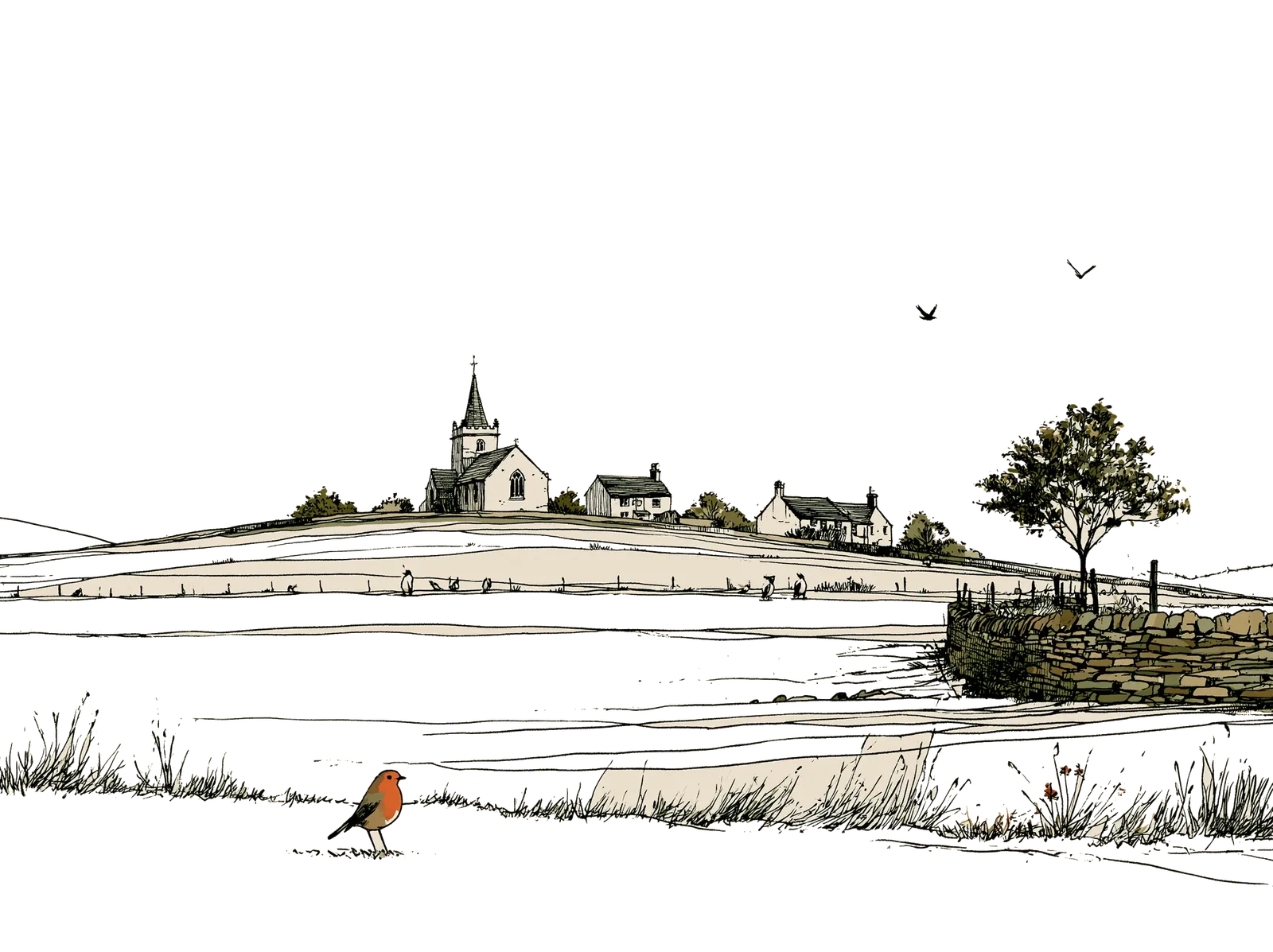
Farnley Tyas sits some 900 feet up, looking out across the old West Riding of Yorkshire. The village is wrapped in Green Belt, and most of it is a Conservation Area with a good number of listed buildings. The land to the north and west is recognised as an area of high landscape value, with ancient woodland close by, and the church spire is a landmark for miles.
The village appears in the Domesday Book of 1086 as Ferlei, and over the centuries it shifted through Farlegh, Farneley and, by 1361, Farneley Tyas. The name most likely means the lea, or clearing, of the ferns. The Tyas comes from the medieval family who held the land, Baldwin le Teys among them, before it passed in time to the Earls of Dartmouth.
Villagers have long been nicknamed the Robinets, after a local tale of Jack Rimington, a steward to the Kayes of Woodsome, said to have returned as a robin to haunt the lanes. The little red-breast has been a friend of the village ever since.
Deep roots
Farnley Tyas is first written down in 1086, but the hill it stands on has a story far, far older. We cannot be certain of much this far back, so what follows leans on the land itself, and on its better-recorded neighbours.
The hard gritstone beneath the village was laid down around 320 million years ago, when this land lay close to the Equator beneath great tropical rivers, their sand and mud settling into the rock that the moors and field walls are still made of. Far, far later, in the last Ice Age, meltwater carved the steep Holme and Colne valleys on either side and scoured the hills, leaving the blanket of peat bog that still cloaks the high moor.
After the ice came the people. Mesolithic hunter-gatherers left scatters of worked flint on the Marsden moors to the west; on Pule Hill a Bronze Age community buried their dead with urns and food for the journey. A couple of miles to the north, Castle Hill grew into one of Yorkshire's great Iron Age hillforts. It is often called a Brigantian capital, but the archaeologists who dug it found it was burnt and abandoned around 430 BC, long before the Romans arrived, so that grand title is more legend than fact.
When Rome held the north, a fort stood at Slack, near Outlane, guarding the road between the great fortresses of Chester and York. It is traditionally identified with a place the Romans called Cambodunum, though no one can prove it, and the romantic notion that it was "Camelot" is just a good story.
After Rome, this was the western edge of the British kingdom of Elmet, absorbed into Anglian Northumbria in the seventh century. It was the Anglians who gave the village its name: Ferlei, from the Old English for a clearing among the ferns, the bracken that still clothes the hillside. Vikings later settled all around (their word for a clearing survives just down the road in Slaithwaite), yet the name of our hill stayed stubbornly English.
And so to 1086, when, for the very first time, Farnley Tyas was written down, and its recorded story begins.
The story in brief
From the gritstone's deep beginnings, through the first hunters and a hillfort, to the village you can walk around today. The further back we go, the more we lean on the wider landscape, so read the earliest dates as the best picture we have.
c. 320 mya
The gritstone the village is built from forms as sand in great tropical rivers, when this land lies near the Equator. It will drift slowly north over the ages that follow.
the Ice Age
Meltwater carves the steep Holme and Colne valleys on either side of the hill and scours the tops, leaving the moorland and its blanket of peat.
c. 6000 BC
Mesolithic hunter-gatherers leave scatters of worked flint across the high moors to the west, around Marsden.
c. 1800 BC
Bronze Age people bury their dead on the hilltops with urns and food vessels, some of which now rest in Tolson Museum.
c. 600 BC
A great Iron Age hillfort rises a couple of miles north at Almondbury. Often called a Brigantian capital, it was in fact burnt and abandoned around 430 BC, long before the Romans came.
c. AD 80
A Roman fort guards the trans-Pennine road between Chester and York at Slack, near Outlane, traditionally identified with a place called Cambodunum.
c. AD 627
The British kingdom of Elmet is absorbed into Anglian Northumbria, and Old English settlement and naming spread across these hills.
before 1086
Anglian settlers name the place Ferlei, the woodland clearing among the ferns, the root of the name Farnley we still use today.
1086
The village is recorded as Ferlei. The name most likely means the lea, or clearing, of the ferns that still clothe the hillside.
1200s to 1370
The Woodsome estate, held earlier by the de Nottons, passes to the Tyas family. They hold it until 1370 and lend the village the second half of its name.
1361
After spells as Farlegh and Farneley, the village is written by 1361 as Farneley Tyas, close to the name it carries today.
1378
John Kaye marries into the estate and Woodsome becomes the seat of the Kaye family for the next three and a half centuries.
1671
John Schofield builds Manor Farm, chiselling his initials and the date above the door. It is still the oldest building in the village.
1732
With no Kaye heir in the male line, the estate passes through marriage to the Legge family, the Earls of Dartmouth, who will shape the village for more than two hundred years.
1698 and 1733
A stone guide post stands at the Thurstonland Road junction, one of the best preserved in the district. It is said to have once carried a sundial.
1820 to 1840
The village hums with cloth-making. Around seventeen employers give work to some nine hundred people in and around Farnley Tyas.
mid 1800s
By the middle of the century the village counts thirty-two farmers, fourteen cloth manufacturers, four butchers, two grocers and two tailors.
1838 to 1840
William, the 4th Earl of Dartmouth, pays for a new church. The foundation stone is laid in 1838 and St Lucius, designed by Chantrell of Leeds, opens in 1840 with its rare dedication.
1910 and 1911
The last of the Legge family leave Woodsome Hall in 1910. The next year it is let to Woodsome Hall Golf Club, which later buys the old timber-framed house.
1923
Farming still shapes the hill. As late as 1923 there are as many as thirty farms in and around the village.
1939 to 1945
In the Second World War the Reading Room becomes the Home Guard headquarters and a radio listening post, known with affection as the bug box.
1955
Architect Peter Womersley builds Farnley Hey as a wedding present for his brother, one of the finest modern houses in the north and later listed.
1966
The Dartmouth family sells the last of the Farnley Tyas estate, closing more than two hundred years of one family holding the land.
2003
The village's last dairy farm gives up milk production, the quiet end of a long farming tradition.
2006
Neighbours come together to form the Farnley Tyas Community Group, which keeps the events, walks and traditions of the village thriving today.
2018
The Rochester Bridge Trust takes on a number of the village farms, houses and properties, a fresh chapter for the old estate lands.
The church on the hill
The village church is unusual before you even step inside, for it is one of very few in the land dedicated to St Lucius, a shadowy figure of legend said to have been an early British king who first welcomed Christianity to these islands.
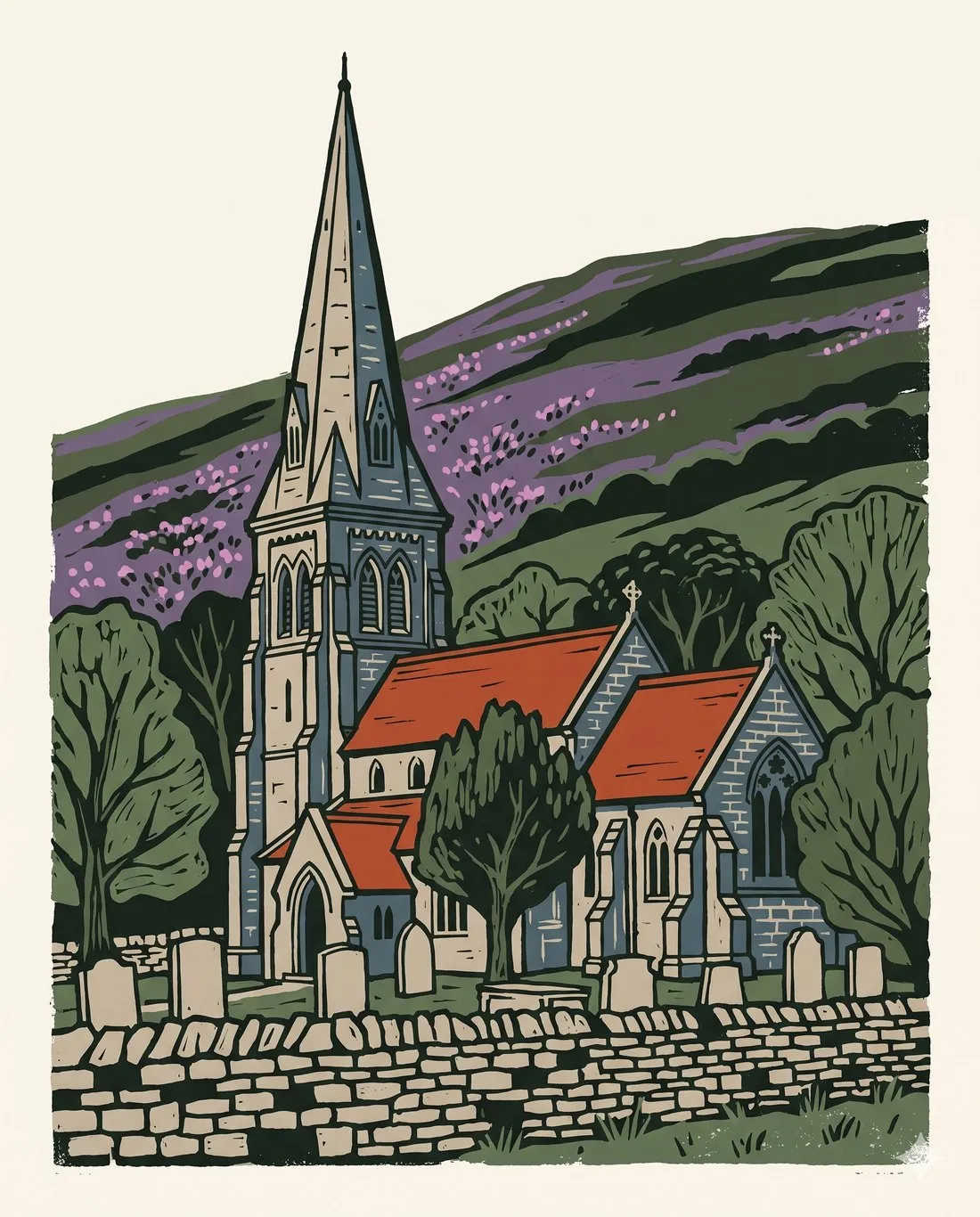
The church was paid for by William, the 4th Earl of Dartmouth. The foundation stone was laid in 1838 and the building, designed by Chantrell of Leeds, the architect of Leeds Parish Church, opened in 1840. It is a handsome Gothic revival church with a west tower and a spire that draws the eye from across the valley, and it was carefully restored in 1880 and again in 1904.
Today the churchyard is cared for with wildlife in mind, an eco-church where wild flowers and quiet corners are as welcome as the congregation. The village war memorial, unveiled in 2014, remembers five local men: Walter Johnsey, William Lodge, Ernest Price, Arthur William Rothery and George Edmund Shaw.
The great estate
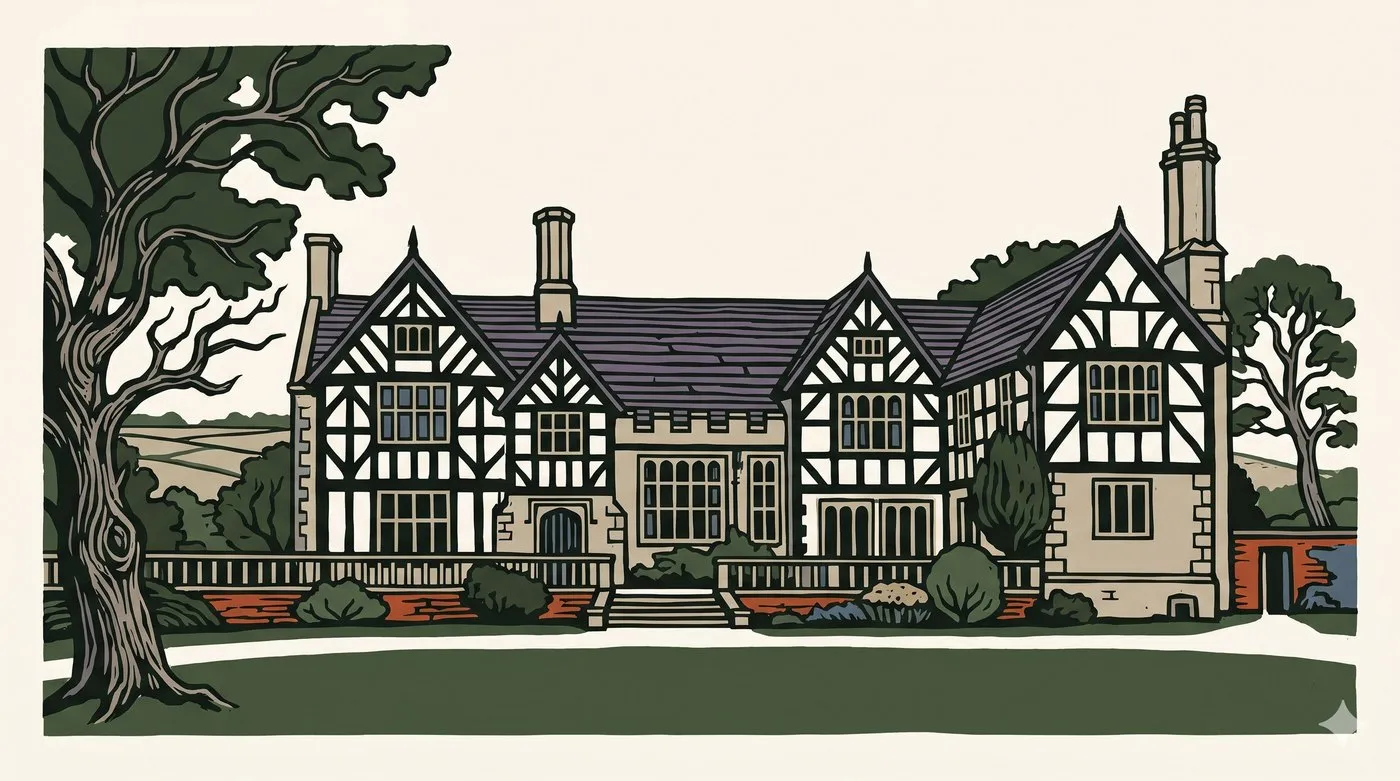
For most of its history Farnley Tyas was an estate village, and its story is bound up with the great house at Woodsome. Held in the thirteenth century by the de Nottons, the manor passed to the Tyas family, then briefly to Sir William Finchenden, whose finches still decorate the hall.
From 1378 it was the home of the Kaye family, who held Woodsome for nearly three hundred and fifty years and built much of the fine timber-framed hall that survives today. Sir John Kaye was made a baronet in 1642. When the male line ran out in 1726, the estate passed through the marriage of Elizabeth Kaye into the Legge family, the Earls of Dartmouth, in 1732.
Under the Earls of Dartmouth the Farnley Feast was held each Whitsuntide, with young men climbing a greasy pole for a prize of mutton. The last of the family left Woodsome in 1910, and from 1911 the hall has been home to a golf club.
Cloth and craft
In the eighteenth and nineteenth centuries the village hummed with cloth-making. Between 1820 and 1840 some seventeen employers in Farnley Tyas gave work to around nine hundred people. By the middle of that century the village counted thirty-two farmers, fourteen cloth manufacturers, four butchers, two grocers and two tailors, a busy little world of its own on the hill.
Farming shaped the village for centuries; there were as many as thirty farms here as late as 1923, and the last dairy farm gave up milk production in 2003. The Dartmouth family sold the last of the estate in 1966, and in 2018 the Rochester Bridge Trust took on a number of the farms, houses and properties. Through all the change, the village on the hill endures, and so does the spirit that keeps it together.
Around the village
The oldest house in the village, with John Schofield's initials and the date carved proudly above the door.
A listed stone guide post at the Thurstonland Road junction, said once to have carried a sundial.
Built between 1838 and 1840 for the 4th Earl of Dartmouth, with a spire that is a landmark for miles.
A fine sixteenth-century timber-framed hall, seat of the Kayes, now home to a golf club.
Peter Womersley's celebrated modern house, listed for its lightness and its optimism.
The village pub, long a gathering place at the heart of Farnley Tyas.
Farnley Tyas in numbers
Find out more
A village history is never quite finished. If you can add to it, or put us right, we would love to hear from you.
Some of the older dates and tales come down to us through generations of villagers, and we have set them down here as faithfully as we can.
Lend a hand
Have an old photograph, a memory, or a tale of the village? Share it, and help us keep the history of Farnley Tyas alive for the next thousand years.